
Six Trends to Watch in Predictive Maintenance in 2026: How Global and Technological Forces are Changing Condition Based Monitoring

2026 will be a year of big changes, both for the world at large and predictive maintenance specifically. The global geopolitical situation is forcing industry to rethink where and how it operates. Meanwhile, demographic changes continue to affect the workforce, particularly in the field of vibration analysis. Can better data management and integration pick up the slack?
Not all changes are so fraught. Technological advances march onward. Sensors are getting better and cheaper, just as AI drives demand for resources to new heights. And methods for interpreting sensor data are improving too. In 2026, predictive maintenance will move beyond rigid thresholds, finding new sources of actionable information.
Read on to learn more about the six biggest trends changing predictive maintenance in 2026.
1. Industry is shifting and growing
Starting a decade ago, tariffs, a global pandemic, and geopolitical destabilization have all rocked the foundations of global trade. With the future of global supply chains and offshore industry uncertain, it seems nearly certain that near-shoring industry will be a major trend in 2026 and beyond.
There are positive forces at work. Interest rates are falling in multiple markets around the world, making investment in near-shoring easier. At the same time, AI-driven compute expansion is increasing demand for data centers and power infrastructure, pushing the already high demand for rare earth elements and other metals to an even higher level. Mining and processing these minerals will see particularly pronounced growth.
With skilled workforces, technological experience, and access to capital, countries like the United States that have spent decades pivoting away from industry are well positioned to pivot back. Some regions even have the opportunity to rebuild using modern equipment and digital infrastructure rather than retrofitting legacy plants.
For predictive maintenance, this is a huge opportunity. Near-shored industry will take advantage of the proven productivity improvements possible through comprehensive and automated equipment monitoring and analytics.

2. Explosive growth in sensor deployment
As micro-electromechanical systems (MEMS), silicon vibration sensors emerged from the same microfabrication advances that produced integrated circuits and microprocessors. Early MEMS concepts date to the 1960s, while MEMS accelerometers appeared in research by the late 1970s and reached mass markets in the early 1990s, developing in step with improvements in semiconductor manufacturing. In 2026, industry will enjoy the benefits of two diverging evolutions in vibration sensors.
First, quality handheld sensor makers are entering the wireless sensor market. This means reliability teams will have more high-end sensor options for continuously monitoring critical assets. Furthermore, reliability teams who teams are familiar with and trust the handheld sensors they already use will be able to easily integrate wireless sensors into existing workflows.
Meanwhile, over 150 generic sensor brands are entering the market. These sensors are not as good as the sensors industry trusts to monitor critical assets, but they have one advantage: price. These will have a big impact on balance of plant monitoring, making it cost effective to monitor every piece of equipment in a plant, not just the most expensive equipment.

3. The retirement decade continues
The baby boom 65 years ago has given us the retirement boom today. Around the world, and particularly in the west, the most experienced employees are retiring. They’re taking 70 % of knowledge with them.
This problem is particularly pronounced among vibration analysts. Currently, there’s limited growth in the field, and even if the pace of growth expanded, it would not keep up with the demands of continuous vibration monitoring. It takes years of experience and specialized training to become a CAT III or IV vibration analyst. Covering the gap tomorrow will take more than simply training more analysts today.
Data will be critical in rebuilding institutional knowledge and making up for lost individual knowledge. This, in turn, will open new questions about how industry uses data.
4. Hardware-agnostic data management
Access and flexibility will have major impact on how effectively data can replace lost personal knowledge. Data ownership will drive decision-making, while integrating data collection and analysis across processes and equipment will unlock huge benefits.
Consider a reliability team taking advantage of the explosion in new sensor options. They choose to monitor critical equipment with high-end wireless sensors from a maker they know and trust from years of route-running experience. They also want to monitor balance of plant equipment with cheap sensors, and they can, but does that mean they need a new dashboard to manage the data from those sensors?
In 2026, the answer is no. Hardware-agnostic data management will allow reliability teams to reap the benefits of monitoring all equipment by collecting and managing data from any sensor, all in one place.
“Companies want to focus on efficiency gains and revenue gains... They don’t want to lock in with any specific hardware.”— Rajet Krishnan, CEO at Viking Analytics
This will also create options for businesses to control their own data. The value of data has been proven again and again to the point that personal data is big business. Business data is as well, but there are many good reasons—from security to change management—why each of our businesses’ data should remain our own businesses’ business.
This shift will be especially pronounced in Europe, where the EU Data Act entered into force in September 2025. The Data Act sets sweeping rules for sharing and using data, with the intent of creating a fairer, more competitive data market.
Critically for predictive maintenance, the Data Act grants access to data to users of connected devices and services. This means that maintenance providers and reliability teams can now access and share machine-health data held by OEMs, thus streamlining data management and integration. It also means that for the first time ever it will be possible for OEMs to monitor other OEM’s machines.
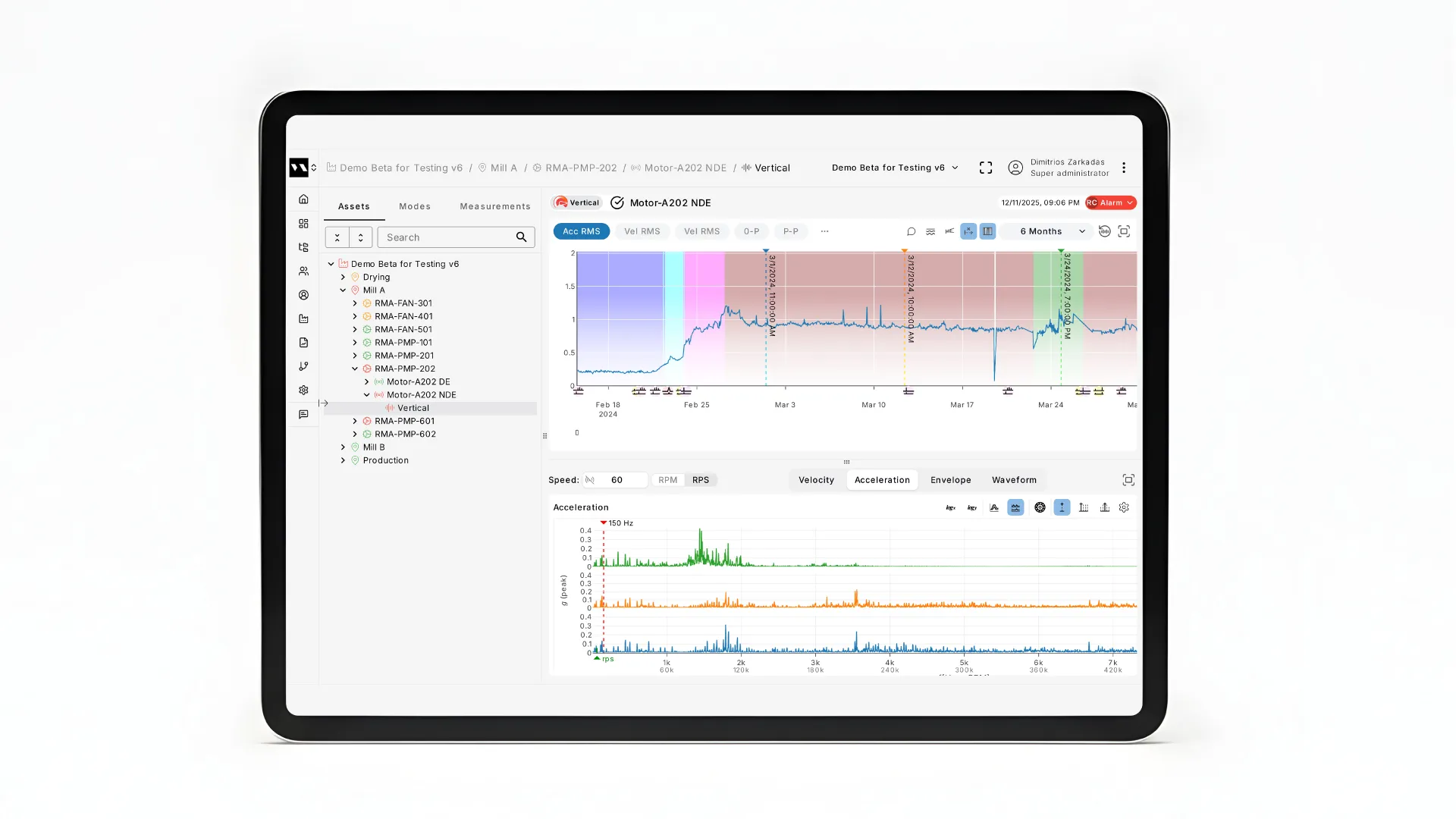
5. Integration between silos. Production, maintenance, ordering, inventory all work together
In practice, predictive maintenance has established how harvesting and analyzing machine data yields more efficient maintenance and more equipment uptime. In theory, this should yield more production. But that can’t happen if production planning is still based on historic data. To realize the full potential of predictive maintenance, maintenance data needs to breach the maintenance silo and inform production processes.
Ideally, this should not be the only data breaching silo—maintenance, logistics, personal, sales, marketing, and financial data can all form an intricate web that informs what gets made when, how, for whom, and at what price.
In 2026, change management will have a growing role in the optimization process that carries data integration forward. This will see changes within each part of businesses brought together in a sum greater than the parts.
6. A shift towards non-threshold, non-rule-based monitoring systems
Industrial machine maintenance has a long legacy of using machine information beyond vibration—or any sensor—data to predict breakdowns. Does a machine feel hotter than usual? Does it smell burnt? Is its oil gritty? Then there’s probably something wrong with it.
Today, vibration sensors have proven their worth for informing predictive maintenance. As the number of sensors increases, traditional threshold-based monitoring systems remain useful, but they struggle to scale across high-dimensional, high-volume data environments without generating noise. Scaling will necessitate a shift to more flexible, holistic approaches.
This can be done by analyzing raw vibration data, but it may also take incorporating more types of data. Humans take for granted that we carry incredibly sophisticated sensors with us everywhere. When we hear noise, smell burnt rubber, feel vibrations, and see rubber fragments, we can practically taste the failing belt. The corroborating observations possible with our innate sensors make us very good fault detecting machines.
If only we could be everywhere at once.
Luckily, advances in sensor technology have also produced an array of other industrial sensors such as electrical current, flow, and IR sensors. These can corroborate the indications of vibration data and provide context for machine-health diagnoses.
At the same time, monitoring may also take on non-machine data such as context and process information. Is a machine running at a different speed? Has a shift changed? Accounting for more information will lead to better informed, more effective analytics that reduce false alarms and produce actionable insights.
“Just collecting a lot of data doesn’t really help anymore. You need to make it actionable.”— Rajet Krishnan, CEO at Viking Analytics
In many ways, this shift will look similar to that made in other sectors. In fraud detection and cybersecurity, as data volume and complexity has grown, static rules have been increasingly augmented by behavior-based and anomaly-detection models. In 2026, predictive maintenance is doing the same.

MultiViz - AI powered vibration analysis-conditioning monitoring for smarter predictive maintenance.