
How Thinking Like a Vibration Analyst Can Optimize Machine-Health Monitoring

Equipment-failures cost industry more than $100 billion every year. At that scale, even small improvements in maintenance planning deliver big returns.
Vibration analysts are the masterminds of industrial maintenance. Based on specialized training and years of experience with industrial machines, they can discern from abnormal machine vibrations which specific components are causing those vibrations, what problems they’re facing, and what repairs are needed.
This has a massive upside for industry. Maintenance costs are reduced. Downtime is prevented. Equipment can operate longer. Plant output increases. Small improvements add up to big returns.
Their success is based on effective machine-health monitoring. Remote machine-health monitoring has never been more cost effective or accessible, but designing an effective monitoring regime isn’t as simple as setting sensors and letting a vibration analyst sort out the data. That’s a recipe for alarm fatigue, missed failures, and inefficient maintenance.
To implement good machine-health monitoring, you need to implement it in a way that’s useful for vibration analysts. You need to think like a vibration analyst.
This article is your guide to thinking like a vibration analyst. Read on to learn what vibration analysts do, the biggest challenges to the profession, and how Viking Analytics is helping to solve those problems by thinking like a vibration analyst.
Vibration analysts monitor and interpret machine vibration data, looking for indications of productivity-killing breakdowns. On their recommendations, maintenance technicians can perform repairs during scheduled downtime, thus preventing unplanned downtime for ad hoc repairs.
At the highest levels of the profession, vibration analysts have years of on-the-job experience and have been through multiple rounds of specialized training and examination. Every step of this journey is specified under ISO 18436-2, a certification that defines and demonstrates vibration analysts’ competencies, ensuring employer confidence.
Those in manufacturing industry who have diligently and consistently applied these techniques have experienced a return on investment far exceeding their expectations. However, the effectiveness of these programmes depends on the capabilities of individuals who perform the measurements and analyse the data.-ISO 18436-2
The work that vibration analysts do is generally prescribed by their ISO certification category. Entry-level analysts primarily gather and report machine information. Higher-level analysts can harness multiple streams of data to make elegant diagnoses and evaluate the validity of the data itself. While analysts may have specific experience that, in specific cases, makes them suited to work beyond their ISO category, the work they do is generally commensurate to their experience and training.
Here’s a brief look at the ISO prescribed career path of a vibration analyst. In general, higher categories come with more experience and analytical skill. This entails the ability to decide what data matters, validate it, and turn it into maintenance action. In short, Cat I collects data, Cat II diagnoses common faults, Cat III designs monitoring programs, and Cat IV handles complex dynamic behavior and edge cases.
Entry-level vibration analysts perform a range of condition monitoring tasks, including collecting, transferring, and identifying errors in vibration data. These analysts can also compare vibration measurements to pre-established alert settings and identify deviations in single-value vibration measurements and trends.
Training is focused on data acquisition, the principals of vibration, and fault analysis, with lesser focus on condition monitoring, corrective action, and equipment.In practice, Cat 1 vibration analysts may spend time route running, collecting vibration data with handheld sensors. This puts them in position to visually observe and report on equipment conditions as well.
With 18 months of experience, vibration analysts are eligible for Cat II testing and certification, expanding their knowledge into testing and diagnostics, reference standards, documentation, and fault severity determination. As such, they can take on more condition monitoring tasks, including defining data collection settings, interpreting test results, and diagnosing and recommending corrective action for common faults.Further training in Cat I competencies, combined with experience gained, also equip Cat II analysts for supervisory roles, guiding, training and defining measurement activities taken by Cat I analysts.
By Cat III, vibration analysts have accumulated significant experience in the field. After 36 months, further training deepens their knowledge in areas already covered in Cat I and II training and reinforced on the job.
Cat III analysts’ breadth of experience and depth of knowledge equips them to design and manage condition-monitoring regimes. They are also prepared to make diagnoses under more challenging conditions, consider more complex systems and input from alternative monitoring technology, and investigate routine data collection. As a result, a Cat III analyst can, for example, differentiate between faults that produce similar vibration frequency patterns.
At the highest level, vibration analysts have at least 60 months experience, have undergone further training in previously trained subjects, and have additional training in rotor and bearing dynamics. The latter prepares them to apply those dynamics to vibration analysis. The former makes them capable performing analyses with a great deal of complexity across a broad range of equipment, and recommending repairs in each case.
If you aren’t already a vibration analyst, you probably realize the safe answer is no, not really. It takes years to become a Cat III vibration analyst and five more to reach Cat IV. Reading the short guide above has given you zero insights into identifying, for example, gas pulsation based on vibrations.
But just because you don’t have the experience or expertise to be a vibration analyst, doesn’t mean you can’t take a vibration analysts’ mindset. Thinking like a vibration analyst means prioritizing signal over noise, validating data before trusting it, interpreting that data in context, and always translating patterns into failure modes and action.
Take the above guide to vibration analyst categories. Interpreting these categories in the context of industry today reveals clear implications for the day-to-day reality of vibration monitoring. You can translate those patterns into action.
Vibration analysts can do amazing things for productivity. Like the ISO itself says, they deliver returns on investment that exceed expectations. And industry agrees. Condition monitoring and predictive maintenance have the capacity to prevent downtime and save thousands for every hour of saved productivity. As the oracles who make this possible, high-level vibration analysts’ skills are as in demand as they are hard won.As a high-level vibration analyst, you stand at the top of a pyramid. You are a rare specialist, capable of solving exotic problems. But the pyramid you crown is supported by a broad base of data collection and cleaning. Without that support, your pyramid can only be so high.
Remember, it takes a long time to become a high-level vibration analyst. Even with training and mentoring in place, it takes years of development for entry-level vibration analysts to reach Cat III. In the meantime, their capabilities are limited.
In our Vibration Severity Zones Miniguide, we took a hard look at the limitations of predictive maintenance using vibration thresholds. In short, while these thresholds are useful, they can deliver false positives, don’t deliver early warning signs, and can’t account for context or operational changes. They also represent the limits of an entry-level vibration analyst’s abilities.Getting the most out of a machine-health monitoring regime takes more than quickly onboarding entry-level vibration analysts.
Surprisingly, a major problem for vibration analysts today is not lack of data, but abundance. The latest sensor technology has made it easier than ever to remotely monitor machines in near-real time. These sensors may be built into machines or provided by excellent third-party sensor experts like Machine Saver, CTC, or pureSignal. They reliably and affordably deliver a steady stream of vibration data.
Remote sensor proliferation has had the perverse result of making vibration analysts jobs harder rather than easier. Consider a recent case in Chile. Nicolaides, a maintenance provider, installed 160 I-care wireless sensors in a pulp mill. These sensors deliver high-resolution vibration data, sampling and transmitting data thousands of times a second. Where analysts used to take one or two measurements per point per month, these sensors now deliver high-resolution vibration data, sampling thousands of times a second, transmitting hourly measurements 24 hours a day, every day, over three axes. That’s 2160 measurements every month from every sensor!
Even CAT IV vibration analysts, human as they are, are forced to ignore 90 % of incoming data from 160 sensors. It’s a mathematical reality. This effectively undermines the value of multi-million dollar sensor networks as analysts resort to basic check-the-threshold routines, leaving the most valuable early-warning signs undetected.
At scale, vibration analysts need more support. Backed by a machine-health monitoring solution that thinks like a vibration analyst, that automatically sorts vibration patterns to weed out false alarms and deliver legitimate issues for deeper analysis, vibration analysts could maximize machine health monitoring.
To vibration analysts, Viking Analytics’ processes should look familiar.
A vibration analyst’s workflow typically follows six steps. Viking automates the first four and assists with the other two:
This is possible because Viking Analytics has created a hybrid AI that combines machine learning with physics-based analytics to process vibration and other data. Grounded in the multi-modal signal processing vibration analysts use, including FFT, harmonics, and envelope analysis, it incorporates specific machine-learning models trained on each measuring point. This is not, however, a simple black-box AI—its output is checked by a proprietary validation engine developed with vibration analysts to cut false alarms.
In short, the Viking Analytics solution is built and trained around the same structure and expertise that goes into thinking like a vibration analyst. Experience or training alone are not enough. By combining machine learning, which is analogous to experience, with the scientific and professional principles that inform vibration analyst training, Viking Analytics has built a tool specifically for vibration analysts.
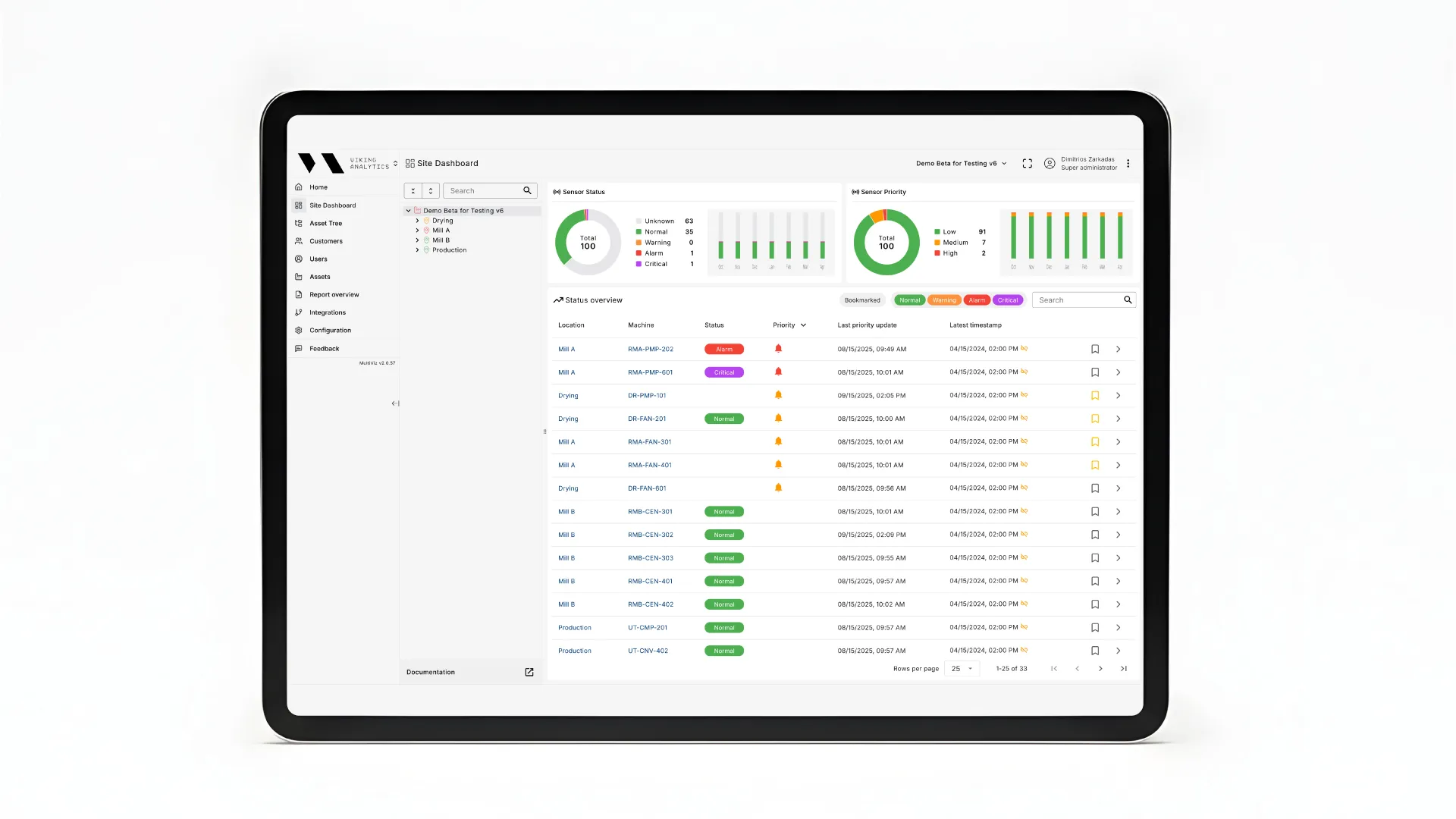
The upshot is, this system is capable of grouping measurements by machine behaviors, or modes, which correspond to different processes in a production line. For example, different modes in a paper mill may correspond to different weights of paper being produced. Modes can also represent different speeds or even different operators using the same machine. These all reflect machines’ normal operating behavior, but when modes change outside of normal operating behavior, Viking Analytics knows. That’s when vibration analysts get valuable information that they can use to quickly prioritize repairs or further investigations.
The Viking Analytics solution has been validated in pilots and full-scale deployments.Compared to simple machine-learning approaches to vibration analysis, it delivers:90 % + fewer false alarms7–21 days earlier detection2–4× higher precisionSuccessful operation in variable environments10× faster analysis
Earlier, we mentioned the Chilean maintenance provider Nicolaides, who was managing a stream of high-resolution data from 160 sensors in a pulp mill. Nicolaides trusted Viking Analytics to process that sensor data. A little more than a month after installing those sensors, Viking Analytics had identified faults on three different machines, preventing three corresponding stoppages that each would have cost Nicolaides’ clients roughly $65k. More importantly, this reduced the time spent triaging alarms. Nicolaides’ analysts could focus on confirming root causes and planning maintenance, building operational efficiency for themselves and their clients.
To learn more about how Nicolaides cut downtime with Viking Analytics, download the case study here.We don’t gain anything by installing 5,000 sensors if we can’t interpret the data. Viking Analytics bridges the gap, turning raw measurements into clear, actionable information.Nicolás Pérez Briones, Monitoring Manager from Nicolaides
Want to learn more? Download the Nicolaides x Viking Analytics case study here.
Vibration analysts deliver incredible returns. Their knowledge and expertise keep machines operating and plants productive; they maximize machine-health monitoring and minimize unplanned downtime. There just aren’t enough of them.
Thinking like a vibration analyst means designing monitoring systems that:
Viking Analytics is here to help.
As a sensor-agnostic machine-behavior intelligence, Viking Analytics’ solution integrates with existing and planned sensor setups, making it possible to scale predictive maintenance operations across entire sites and factories. It’s deployable in hours. It cuts false alarms by 70–90 %. It lets vibration analysts focus on what really matters: preventing unplanned downtime.

MultiViz - AI powered vibration analysis-conditioning monitoring for smarter predictive maintenance.