Predictive Maintenance Got its Assumptions Wrong. How Embracing Reality Shows Us the Future of Industrial Condition Monitoring

For as long as there has been industrial equipment, clever people have been observing that equipment for signs of pending failures and preventing them. Today, the practice of predictive maintenance has flourished, benefiting from technology to monitor equipment and process sensor data–broadly called industrial condition monitoring.
The rise of industrial condition monitoring has created growth opportunities for predictive maintenance. And, with them, growing pains.
In some cases, old assumptions from old processes have held back systems trying to leverage new technology. In others, assumptions about what technology could or should do have undermined the effectiveness of capable systems. Once, these assumptions created a great deal of hype. Now, this hype has given way to disillusionment.
But the truth is, industrial condition monitoring still delivers real value to global industry. And there’s more to come. Millions of machines are essential for production yet aren’t connected to industrial condition monitoring systems. Connecting just a fraction of them would create tens of billions in value, with long-term prospects for far more.
It will just take stepping out of the shadow of predictive maintenance’s assumptions.
This article takes an honest look at those assumptions. Viking Analytics’ years of experience providing an industrial condition monitoring tool have revealed flaws in each one.
Assumptions:
At the same time, these years of experience have also revealed opportunities for massive growth in industrial condition monitoring. Read on to learn how reality shows the way.
To be clear, industrial condition monitoring can and does deliver many of the benefits promised by predictive maintenance. The sensors and automated analytics at work in industrial condition monitoring can and do improve maintenance performance and overall productivity. This just doesn’t always work the way predictive maintenance solutions marketed in the past expected.
The thing is, when facts invalidate assumptions, they also show us how to adjust our thinking. As soon as we understand why predictive maintenance’s assumptions were wrong, we also understand how to deliver value based on what’s right.
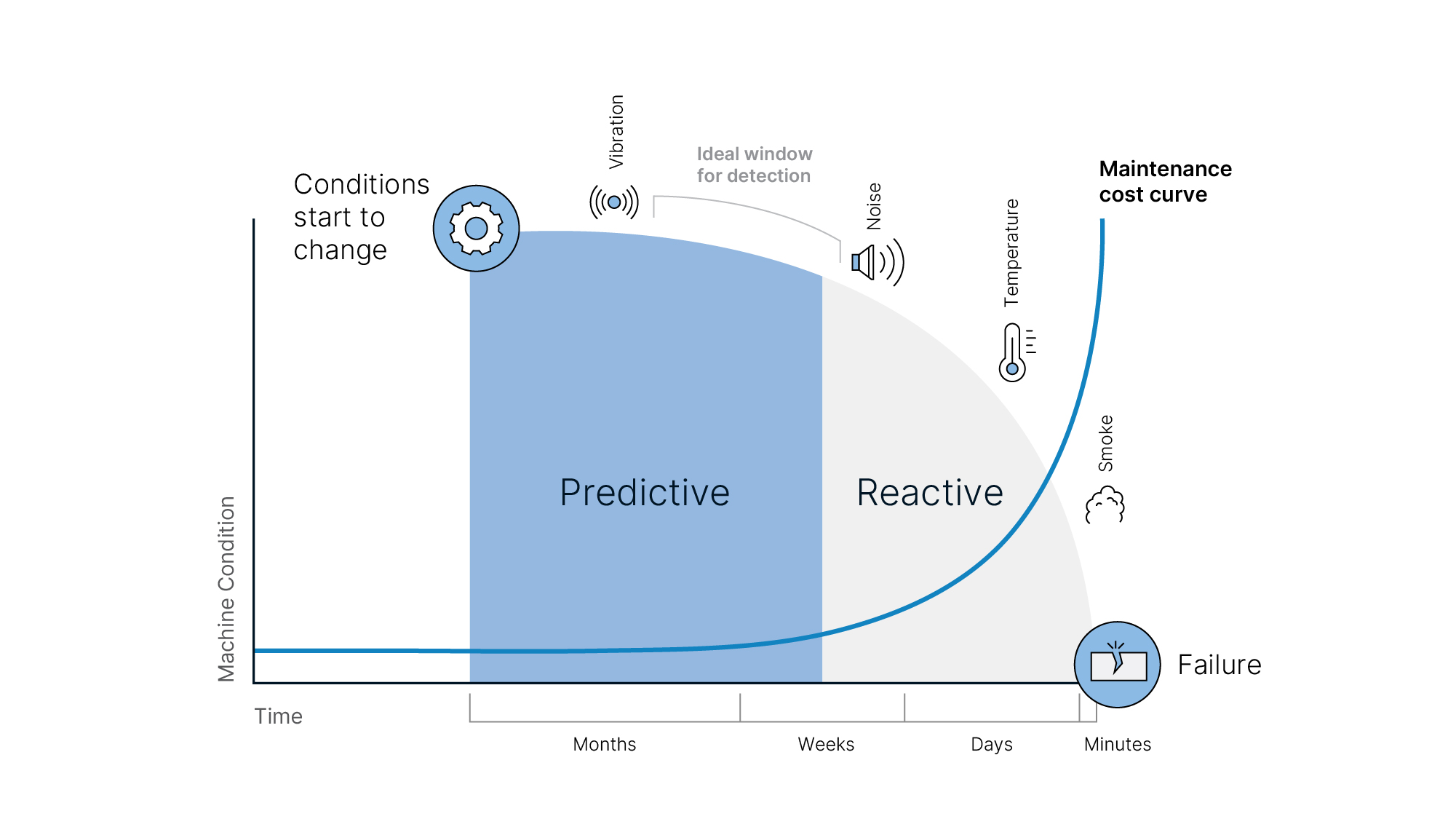
Here’s a standard pitch for predictive maintenance: “Detect failures months in advance, plan maintenance with lots of time to prevent them.”
This is certainly possible. With remote sensors monitoring key points on equipment and automated analytics tuned to detect the signs of failure, predictive maintenance solutions can and do do this.
The main problem is that this is also possible with periodic manual checks. The expensive sensor installation and analytics package isn’t doing anything that a technician with a handheld sensor couldn’t accomplish in a bimonthly sweep.
The real value in the monitoring system is catching things in between–especially the kind of things you can’t afford to miss. And even if a fault is detected months early, many teams don’t have procedures in place to do anything about it. Nor do they want to create these procedures.
This is something our customers have told us: When an alert is too early, it’s noise.
And so it is. If the value in alerts lies elsewhere than “as early as possible”, the no-value alert is nothing but noise.
While alerts as early as possible aren’t always welcome, there is an ideal window for detection. When, exactly, is very situation specific. It depends on the equipment in question, the severity of the fault, how the equipment is used, how it fits into the greater processes of the plant, and so much more. It varies from organization to organization, and even from individual to individual within organizations.
One thing that never changes is that getting reliability teams the information they need takes ruthlessly cutting noise, such as pointless early alerts and false alarms. It also takes sensitivity to the team’s needs. This is possible to accommodate in industrial condition monitoring solutions. Doing so delivers great value.
Remaining useful life is the predicted time until equipment no longer meets desired performance. Derived from analysis of failure mechanisms and signs of wear, it’s long been desirable in condition-based maintenance.
Therefore, the assumption goes, it must also be desirable in cutting-edge predictive maintenance solutions. With all the data coming in from condition monitoring sensors, surely predictive maintenance could extend the remaining useful life for any piece of equipment.
There are a few problems with this assumption.
First, there’s the problem of what users expect “remaining useful life” to tell them. It looks like it should be a number indicating time. But the best it can offer is a statistical estimation.
Furthermore, it takes time to collect data. Naturally, there will be no data on how long new equipment can run until failure until said equipment has run until failure. At that point, what good is a prediction? And conditions in plants can vary widely; where operations deviate from those where data was collected, that data and remaining useful life predictions based on it are no longer sound. Finally, even where sufficient data is available, the confidence interval of these predictions is so wide as to be useless.
In one case, a customer of ours ran a machine for two years on a defective bearing. Was this consistent with the equipment’s remaining useful life? The best we can say is, “maybe.” Does this reflect in any way on the success of a predictive maintenance program? No.
With industrial condition monitoring, reliability teams don’t even need remaining useful life. And even if they had it, what would they do with it?
Consider a trip to the doctor where you receive bad news: if you carry on living the way you do, you’ll only live five more years. What would you do with this information? You would likely change your behavior–you might eat more vegetables, get better sleep, give up base jumping. Five years come and go and you continue to live. By changing your behavior, you’ve invalidated the doctor’s estimation.
Ultimately, what was the value of that estimation? Maybe it was an effective scare tactic, but even that was only in service of what really mattered: that you changed your behavior.
This is also what matters in industrial condition monitoring. By tracking changes in behavior–especially unexpected changes–you track the things that decrease lifetime. You can then make the changes that extend lifetime. Knowing the lifetime itself does not tell you what to do.
As far as tracking the success of maintenance programs, there are plenty of indicators that are simple, accessible, and reflect actual value for reliability teams: false alarms per sensor, dollars saved per sensor per year, hours vibration experts can focus on actual analysis. Timely, prioritized, behavior-based alerts will get results.
There’s an intuitive bit of logic behind this assumption. If maintenance isn’t done, equipment breaks down. If equipment is broken, production stops. Maintenance, therefore, is essential for production.
This is the foundation of one of predictive maintenance’s central value propositions: predict and prevent downtime for equipment failures, and you save production.
This is correct. But while maintenance is essential for continued production, it isn’t sufficient.
Consider any industry in equilibrium. With no incentive to produce more, preventing downtime only as a means to increase production offers no value. And there are any number of concrete scenarios that could also make this true, from limited raw materials to limited demand, from logistics challenges to labor shortages. Ultimately, maintenance is typically viewed as a cost center. Maintenance departments are underfunded and are not considered part of the production cycle.
Obviously, maximizing the value of predictive maintenance needs a wider view of plant-wide concerns.
Coordination to achieve plant-wide objectives is critical. And in reality, this is how plants work. Different stakeholders with different responsibilities work towards shared goals. Industrial condition monitoring needs to support this by delivering insights beyond the maintenance silo.
Consider the above case of the equipment that ran for years on a bearing defect. This was undoubtedly a choice made through careful consideration of objectives both within and beyond maintenance. And because it was in line with plant-wide objectives, it was in line with maintenance objectives.
Any system developed to make maintenance more successful needs to enable free data sharing across all systems and departments. With intuitive data presentation that’s tuned to different stakeholders, streamlined reporting, and flexible data sharing, big-picture coordination becomes reality.
Good predictions are based on solid mechanical regularities. Predictive maintenance is no different: there are consistent connections between sensor data, machine condition, and maintenance. So, if we’re already exploiting the connection between sensor data and machine condition, why not go all the way? Why not diagnose the failure and prescribe the maintenance?
Consider again the above decision to run a machine for two years with a bearing defect. This was a complex decision, accounting for many variables, made by several stakeholders. The conditions here were anything but mechanical or regular. A predictive maintenance solution that went ahead and automatically scheduled maintenance at the first sign of a bearing defect would be operating well beyond its useful ability.
Ultimately, plant leadership will make the right decision. But that takes data from many different systems that are completely siloed. It also takes a great deal of training and experience. Individual stakeholders will always have access to information that’s not available in common systems. And even if a predictive maintenance solution could access all silos and somehow capture the personal knowledge of every involved individual, it still couldn’t make decisions about scenarios that hadn’t already been seen or learned.
But there is help. By automating data processing, industrial condition monitoring helps make that decision easier, faster, and better informed. Viking Analytics’ MultiViz provides filtering, prioritization, and preliminary recommendations. It leaves the final call with the team.
Some predictive maintenance solutions–may they rest in peace–were built on the assumption that they could simply let a machine-learning algorithm loose on a connected plant and watch the magic happen. The solution would learn on the job, connecting sensor data from failures and identifying when they happened again.
The problem with this assumption was that algorithms trained on the job never got enough labeled failures such as misalignments or bearing faults for any given process. The machine learning solution could spend months waiting to learn a failure. Even when this finally happened, the connection between sensor data and failure was severed by any change in equipment operation. Something as simple as a shift change could create an entirely new scenario that the system would again need to spend months waiting to learn from.
Some predictive maintenance solutions attempted to get around this problem by pretraining algorithms on existing data. Unfortunately, global models don’t exist. Any machine learning model trained on particular data derived from particular circumstances cannot translate that training to circumstances not yet seen.
Machine learning is ideal for discovering patterns in massive volumes of data. But there’s no need to discover patterns that analysts already know. Vibration analysis is a mature and standardized field. AI for industrial condition monitoring can benefit from using that established knowledge.
It’s important, however, to not fall into the trap of creating rule-based systems based on fulfilling requirements that indicate specific outcomes. These systems tend to be fragile. Designed for specific conditions, they break when conditions change and can seriously hold back scaling.
Meanwhile, there is still a place for machine learning. It just needs to work within its limits. Viking Analytics’ behavior-based analytics at work in the MultiViz platform includes self-supervised learning of typical machine behavior. This allows the solution to identify changes without establishing baselines or thresholds that can break at scale.
A few years ago, the above assumptions fed into a great deal of hype for predictive maintenance solutions. As it became clear that these solutions couldn’t meet inflated expectations, hype collapsed, giving way to a great deal of disillusionment.
Today, industrial condition monitoring has tested these assumptions, rejected them where they failed, and adjusted accordingly.
There’s a huge upside to this scientific approach. An outsized proportion of global equipment is essential to operations but still goes unmonitored. By homing in on what really works, we can successfully monitor that equipment.
5 % of equipment is critical. This is the set of high-value machines at the core of different operations, directly producing each plant’s respective output. As such, this equipment is already heavily monitored, often by the OEMs.
40 % of equipment, meanwhile, is essential for keeping that critical equipment running. Think power plants, environmental systems, pumps, compressors–a broad set of equipment that isn’t directly producing, but is still vital to keeping production going.
Less than 5 % of this essential equipment is connected.
Monitoring the rest of it is a huge opportunity, both for plants that embrace condition monitoring at this scale and for anyone who can deliver. Even growth to only 25 - 30 % creates a market for software alone worth over $30 billion.
Finally, there’s the 55 % of equipment that is neither critical nor essential. None of this equipment is currently monitored, and at this point it doesn’t make economic sense to do so. But this can change. As low-cost sensors continue to enter the market and scalable analytics take hold, there’s enormous potential for long-term growth monitoring this equipment.
The scale of the opportunity is matched only by the scale of the challenge. Good thing we’ve already figured it out.
Prior attempts at monitoring essential equipment have attempted to translate what worked for critical equipment to a far larger fleet of equipment.
On the hardware side, this has been supported by a robust market of low-cost sensors.
Software has needed to adapt. The flawed assumptions of predictive maintenance kill monitoring at scale. Analytics built around hard thresholds and rules deliver a crush of false alarms.
Consider this scenario: a plant installs 1000 sensors on 300 pieces of essential equipment. It takes 12 months to configure the thresholds and rules. And the result is still 500 alarms a week.
Already facing a wave of retiring analysts, industry doesn’t have the time or expertise to deal with this. Without mechanisms or adjusted workflows in place that can deal with additional data, plants should expect alarm fatigue, failed monitoring systems and failed predictive maintenance strategies.
VIking Analytics has solved this problem. Deploying behavior-based analytics, built to face the realities of industrial condition monitoring, 500 weekly alarms shrink to 20.
The future is taking industrial condition monitoring to a massive scale. We’ve written before that monitoring is at an inflection point. Like cybersecurity and financial fraud detection, condition monitoring is moving from rule-based to behavior-based analytics. The result will be rapid scaling.
Here’s what to look for.
The market is rich with sensors for both critical and essential assets. Facing an entrenched patchwork of installed sensor brands, the software of the future will be able to work with as many as possible. This is only possible through hardware agnosticism.
Right now, Viking Analytics monitors over 14,000 sensors across over 150 sites via 45 partners and 15 sub-partners. This includes OEMs ABB, Weir, and Honeywell.
Meanwhile, over 70 % of deployed sensors working with Viking came from customers migrating from another monitoring platform. It all works because MultiViz is hardware agnostic.
Lubricated by recent regulatory changes, migration between services will increase.
The EU Data Act, brought into force in November 2025, mandates that providers of connected products and services make generated data available to customers. It also mandates that they allow customers to switch to competing services with that data intact.
For a data-intensive industry like industrial condition monitoring, this creates unprecedented opportunities for well-positioned service providers.
Learn more about the EU Data Act here.
One knock-on effect of data liberation is that it’s now easier than ever to free data from silos and coordinate plant wide. While immediate benefits will be felt in maintenance through freeing the market for services and data leverage, in the future this will enable seamless integration with enterprise resource planning.
In practice, this will support the kind of aligned maintenance planning that creates real returns. And that may look drastically different from how planning looks today. Elegant coordination will become possible, with staffing, logistics, and maintenance planning together using the same data.
Reality has punctured many assumptions behind predictive maintenance. Earlier fault detection isn’t always better. Remaining useful life isn’t that useful a metric. Maintenance and production both work best aligned with plant-wide goals. No predictive maintenance solution can do it all. And machine learning alone can’t figure out machine faults.
This experience has taught us what creates real value. We can deliver alerts when plants need them. We know what indicators are useful. We understand the relationship between maintenance and the rest of the plant. We see the limits of automation. And we’ve made a hybrid AI that leverages the full power of machine learning and vibration science.
Against a backdrop of real need and huge opportunity, Viking Analytics is perfectly positioned to apply these lessons. There’s an untapped market right now worth over $30 billion for monitoring software. Long-term prospects are several times that. Regulations and technology have aligned to make hardware agnostic analytics the answer to delivering connected industrial condition monitoring at that scale.
Want to take part? Get in touch here.

MultiViz - AI-powered vibration analysis and condition monitoring for smarter predictive maintenance.