New to the topic? Start with our introduction: What is condition-based monitoring?
Components of a condition-based monitoring system
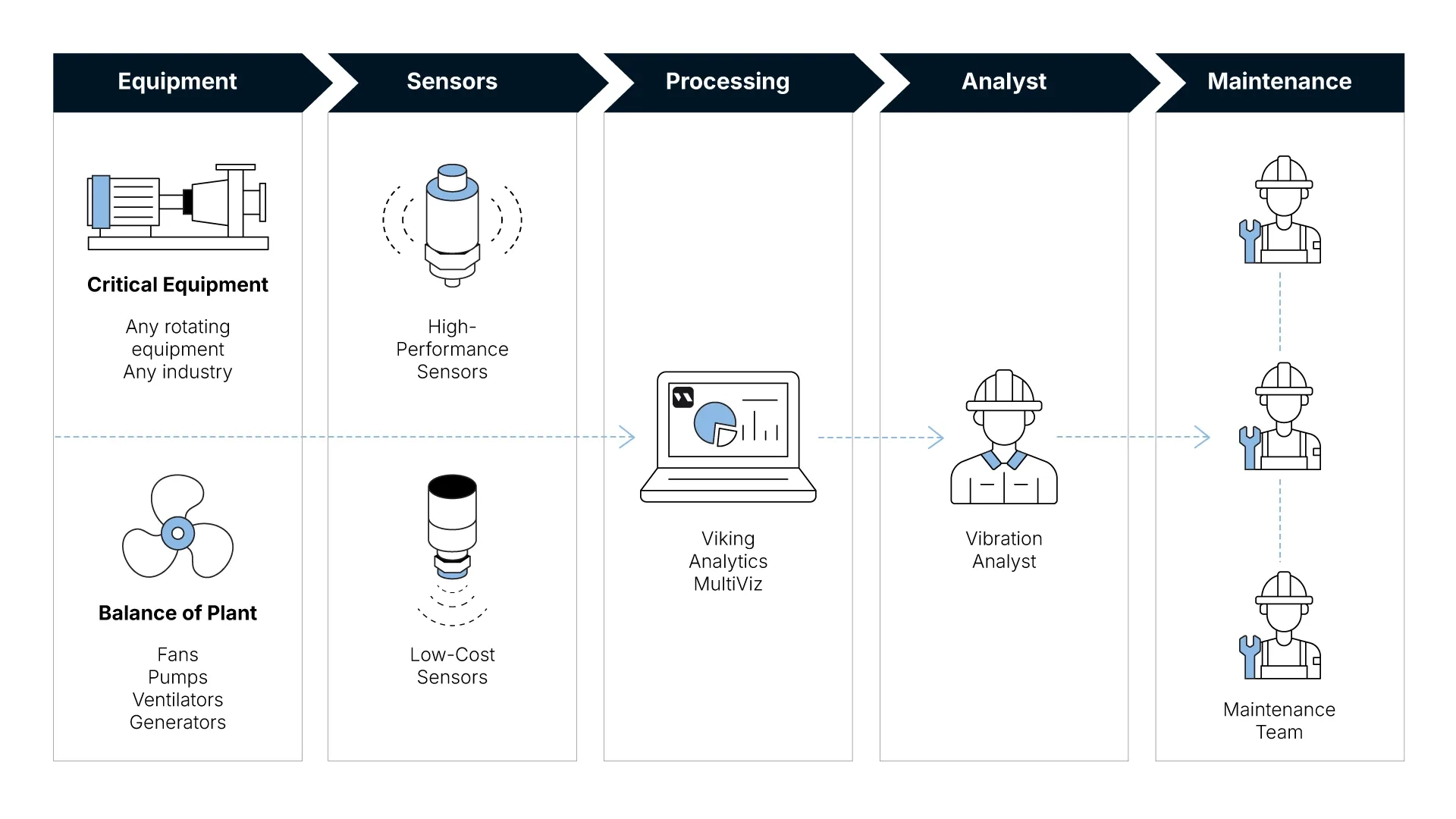
- Sensors that measure vibration, temperature, current or oil condition on each machine.
- Data collection through handheld routes, wireless sensors or permanently mounted online sensors.
- Analysis software that turns raw signals into indicators such as RMS, kurtosis or envelope values, and compares them with each machine's normal behavior.
- Prioritization that ranks the machines needing attention, so the team knows what to fix first.
- Workflow integration with your CMMS, so findings become planned work orders.
Why the software layer matters most
The hard part of a CBM system is not the sensors; it is the data. Continuous monitoring at scale produces more data than analysts can review. Threshold-based alarms generate frequent false alarms and miss context, such as machines that run in several operating modes. Behavior-based software learns what normal looks like for each machine and flags only meaningful changes.
Which sensors does a CBM system need?
You don't need new sensors to start. Analytics software like MultiViz works with almost any sensor, including handheld units. Legacy analogue sensors need a digital signal; adapters (for example from Wilcoxon) solve this.
The right sensor depends on the asset. High-performance online sensors suit critical, high-value machines. Low-cost wireless sensors make it affordable to cover balance-of-plant equipment such as fans, pumps and ventilators, whose failures can still be costly.
Sensor partners that work with MultiViz: ABB, Althen, CTC, Honeywell, iotnest.ai, Machine Saver, pureSignal, SPM, Wilcoxon. See all partners
Remote and online CBM systems
Machine-mounted sensors send vibration, temperature and current data to software that analysts can review from anywhere. Remote CBM lets one analyst cover several sites, which is how service providers scale their monitoring services.
Condition-based monitoring techniques
Vibration analysis · oil analysis · infrared thermography · ultrasound · motor current signature analysis · oil condition sensors · audio-visual inspection. The strongest systems combine techniques: vibration data becomes far more accurate with context such as temperature, speed and operating state. Full comparison: types of condition monitoring.
A CBM system in practice: a pulp mill example
In 2023, Chilean maintenance provider Nicolaides installed 160 continuous-monitoring sensors in a pulp mill. Instead of manual alarm settings and checking every alert by hand, they used MultiViz to prioritize machines automatically.
By January 2024, MultiViz had flagged early warnings on multiple critical assets. Each unplanned stop, typically an eight-hour event, cost their clients about USD 65k in repairs, lost production and emergency work. Trusting the prioritization let the team monitor more equipment and serve more clients. Read the case study
What does a CBM system cost?
Cost depends on four things: the number of assets you monitor, the type of data collection (handheld routes, wireless or online sensors), software licensing, and the analyst time needed to review findings. Reusing sensors you already own and letting software prioritize machines keep the last two down.
- Removes unnecessary scheduled maintenance
- Prevents costly unplanned stops
- Reduces spare-parts inventory, since teams know what will need replacing
CBM system vs. condition-based maintenance vs. predictive maintenance
| Term | What it is |
|---|---|
| Condition-based monitoring system | The sensors and software that measure machine condition (the tools) |
| Condition-based maintenance | Doing maintenance when that data shows a need (the strategy) |
| Predictive maintenance | Forecasting failure from trends or AI, a step beyond CBM |
More: condition-based maintenance.
Frequently asked questions
Is a CBM system the same as condition monitoring software?
The software is one part of it. A CBM system also includes the sensors, the data collection method and the workflow that turns findings into maintenance work.
Do I need new sensors for a CBM system?
No. Sensor-agnostic software such as MultiViz works with existing online sensors and handheld routes from 50+ brands.
Can a CBM system work without a vibration analyst?
Yes, for most day-to-day decisions. Software that learns each machine's normal behavior and ranks machines by urgency lets teams without a dedicated analyst act on the data. Complex diagnoses may still need an expert.