Open side navigation

Symptom: Asynchronous Envelope Harmonics
Definition
When a family of peaks appears in the envelope spectrum above 1× RPM but at orders that are not whole numbers (e.g. 3.6×, 7.2×…), they are called asynchronous envelope harmonics.
Characteristics
- Not locked to the shaft. The repeating event happens faster than once per revolution, but at a fractional order.
- A bearing fingerprint. Rolling-element bearing defect frequencies (BPFO, BPFI, BSF) are classic non-integer orders.
- Envelope, not velocity. Also flagged when the harmonics show up in the envelope but not in the velocity spectrum, a sign the source is a modulated high-frequency impact rather than a low-frequency force.
Possible faults
- Outer-race bearing faults (BPFO). A steady non-synchronous family, often the first thing to appear.
- Inner-race bearing faults (BPFI). Non-synchronous peaks, frequently with 1× RPM sidebands from the load zone.
- Rolling-element / ball faults (BSF). Non-synchronous peaks, sometimes modulated by the cage frequency.
- Process-related harmonics. Flow, cavitation or other process events that repeat at a non-integer rate.
How MultiViz detects it
- MultiViz searches the squared envelope spectrum for prominent, stable peaks and groups them into harmonic families.
- Each family is compared to the running speed and classified by its order.
- Families whose fundamental sits above 1× at a non-integer order are flagged as Asynchronous Envelope Harmonics.
- Each detection reports the estimated RPM, the fundamental order and every harmonic order.
What it looks like
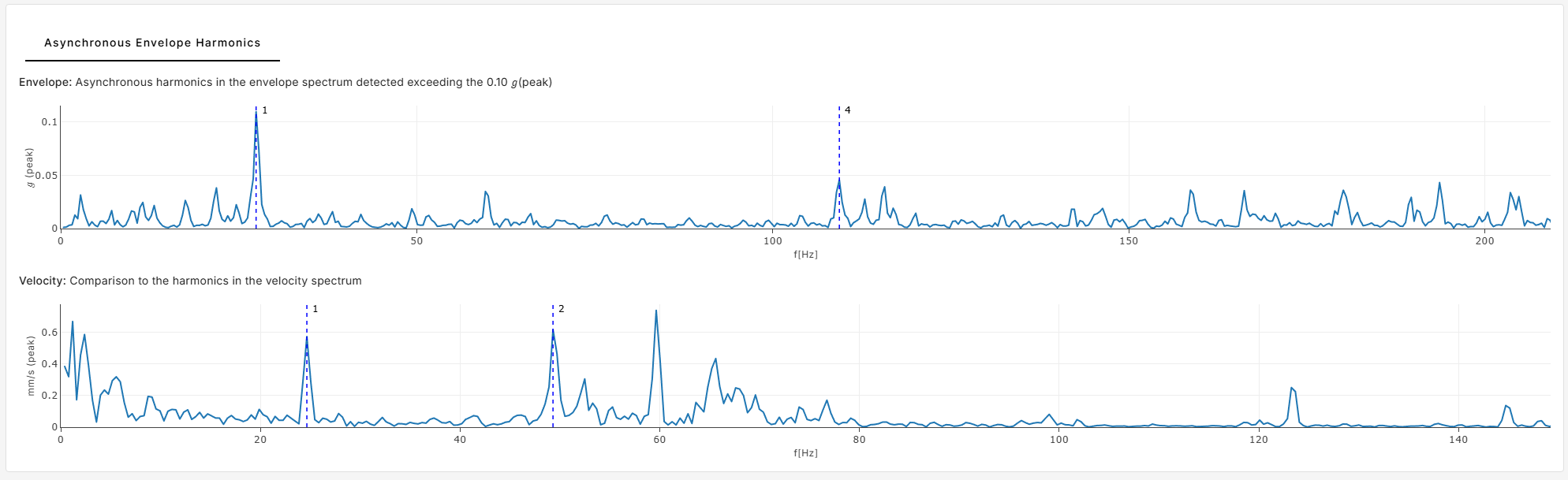
See all 11 symptoms in the Symptoms overview.