Open side navigation

Symptom: Synchronous Envelope Harmonics
Definition
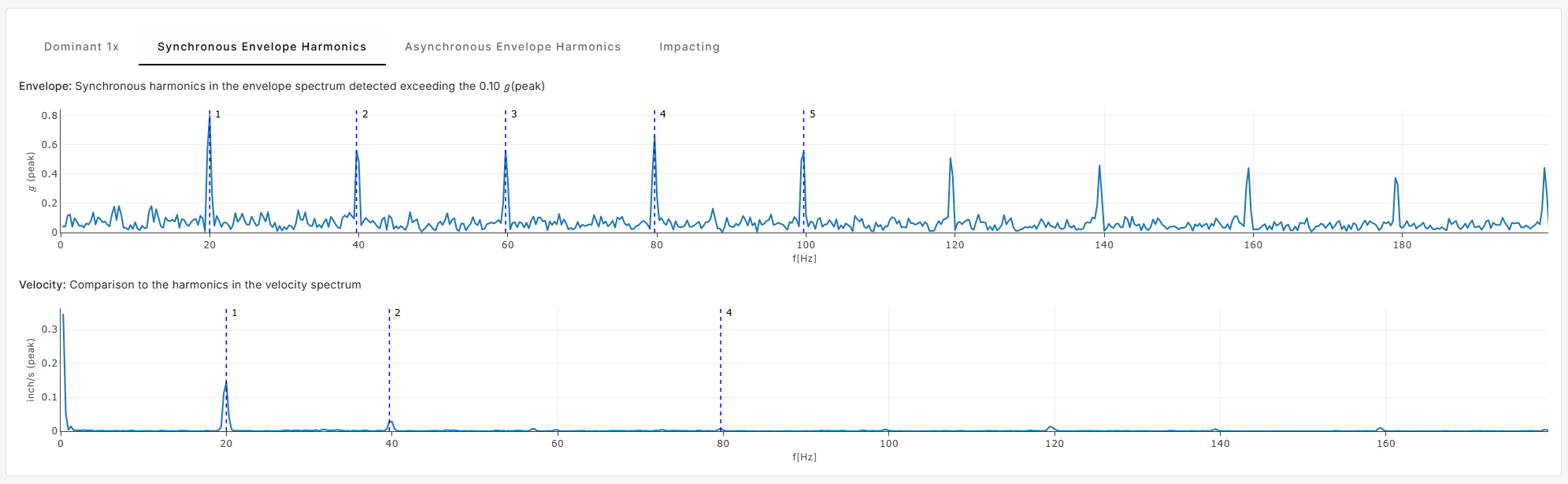
When several peaks in the envelope spectrum are integer multiples of the running speed (1×, 2×, 3×, 4×… RPM), they are called synchronous envelope harmonics.
Characteristics
- Synchronous. The repeating event happens an exact whole number of times per revolution, so its order is 1.00, 2.00, 3.00…
- A family, not a single peak. Several harmonics of RPM appear together in the envelope. A 1× peak by itself is not very diagnostic.
- Why the envelope. Many faults excite high-frequency resonances that are modulated by a low-frequency event. Demodulating with the envelope makes that slow repetition rate visible.
Possible faults
Synchronous harmonics in the envelope mean something is happening at a whole multiple of shaft speed. The most common causes:
- Mechanical looseness. Typically a long family of harmonics (4×, 5×, 6×… and beyond).
- Inner-race bearing faults. The load zone modulates the bearing impacts at 1× RPM, giving RPM sidebands and a synchronous family alongside the non-synchronous bearing peaks.
- Misalignment / coupling issues. Strong 2× RPM in the envelope, often together with 1× and 3×.
- Bent shaft or rotor rub. Repeating impacts locked to shaft rotation.
- Blade or vane pass effects. On fans, pumps and compressors: peaks at number of blades × RPM, which is also a synchronous order.
How MultiViz detects it
- MultiViz automatically searches for prominent stable peaks in the envelope.
- Each detected peak is grouped into families.
- Families that line up with integer multiples of the running speed (order ≈ 1.00, 2.00, 3.00…) are flagged as Synchronous Envelope Harmonics.
- For each detection MultiViz reports the estimated RPM, the order of the fundamental and the orders of every harmonic.
What it looks like
See all 11 symptoms in the Symptoms overview.